
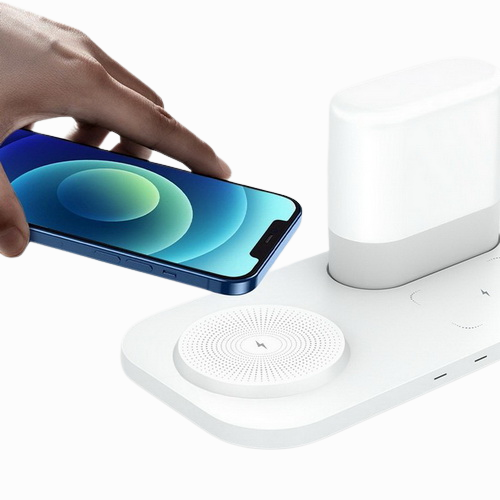
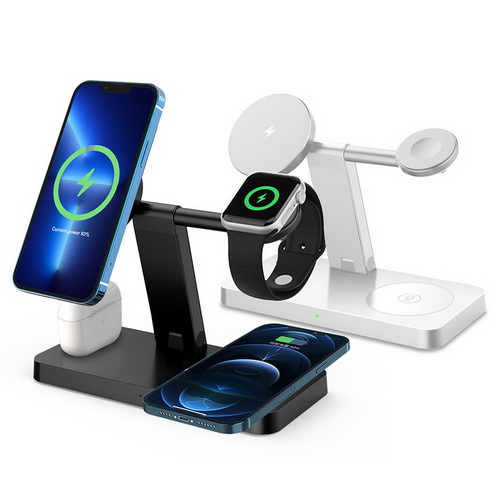
Since the popularization of wireless charging technology, user feedback on its experience has been contradictory: on the one hand, it brings the convenience and neatness of being free from cables; on the other hand, its significantly slower charging speed compared to wired fast charging has long been a core pain point for users. Many people are accustomed to viewing wireless chargers as a “trickle-down” tool at night or on their desks, rather than a rapid rescue solution in emergencies. However, with the introduction of the Qi 2.2 standard and its combination with 65W high-power chargers, this long-standing performance bottleneck is being completely broken, and wireless charging is officially entering the high-speed era.
The Speed Dilemma of Wireless Charging: The Long Evolution of Technological Bottlenecks
The slow speed of early wireless charging stemmed from the dual constraints of technology and safety. Taking the first-generation Qi standard as an example, its charging power was generally between 5W and 7.5W. Although there were subsequent improvements, most remained around 15W. This power limitation stems primarily from several key considerations:
Energy transfer efficiency and thermal management: Wireless charging transmits energy through electromagnetic induction, inevitably resulting in energy loss, which is dissipated as heat. Higher power means even slight misalignment of the coil leads to greater energy loss and more severe heat generation. Excessive heat not only damages battery life but also poses safety hazards. Therefore, in the early stages, lacking efficient heat dissipation and precise alignment technologies, conservative power settings were inevitable.
The challenge of charging coil alignment: Traditional Qi chargers rely on users manually placing the device in the center of the charging pad. Misalignment drastically reduces charging efficiency and slows down charging speed. This somewhat unpredictable charging experience further limits the feasibility of increasing power.
The challenge of standardization: In the early stages of wireless charging development, multiple technical standards and proprietary protocols existed in the market, leading to market fragmentation. Manufacturers focused more on building their own wired fast charging ecosystems, showing relatively less motivation to invest significant R&D resources in developing a unified wireless high-speed charging technology.
These factors collectively led to wireless charging being labeled “convenient but inefficient” for a long time, forcing users to compromise between convenience and speed.
Qi 2.2 Breakthrough: The Cornerstone of Precise Alignment and Efficient Transmission
The real turning point began with the birth of the Qi 2 standard, and Qi 2.2 further unleashed its potential. The core innovation of Qi 2 is the full integration of Apple’s MagSafe technology’s “Magnetic Power Profile” (MPP). This change fundamentally solved two key challenges of wireless charging.
MPP achieves precise alignment by integrating a set of powerful magnets into the charger and device, ensuring “instant” attraction. This design brings immediate advantages:
Improved Transmission Efficiency: Precise coil alignment minimizes energy loss during transmission, allowing more energy to actually charge the battery.
Optimized Heat Control: Reduced energy loss effectively alleviates heat generation during charging. This provides a crucial safety foundation for increasing charging power.
Unlocking Higher Power Caps: The MPP protocol itself was designed to support higher power, raising the official power cap of Qi wireless charging from 15W to 30W and paving the way for subsequent higher power standards.
Qi 2.2, as an evolution of this standard, further optimized the protocol specifications, ensuring interoperability between devices from different manufacturers and clearing obstacles for the standardization of 65W and even higher power wireless charging technologies. It can be said that Qi 2.2 is a solid foundation for building a high-speed wireless charging experience.
The Arrival of 65W: When “Convenience” Meets “Extreme Speed”
If Qi 2.2 solved the problem of “how to safely and efficiently transmit energy,” then the emergence of the 65W charger answers the question of “how fast can it transmit?” When the precise alignment and efficient heat dissipation capabilities of Qi 2.2 meet the surging power of 65W, the wireless charging experience undergoes a qualitative leap.
What is the concept of 65W? In the wired charging field, this is sufficient to charge a mainstream smartphone to over 80% in 30 minutes, and even provide charging support for some thin and light laptops. When this power level is applied to wireless charging, it means:
Breaking down the boundaries of charging scenarios: Wireless charging is no longer exclusive to “overnight charging.” Users can get a considerable power boost during the ten or so minutes they spend getting ready in the morning, or when they temporarily place their phone on their desk. It can perfectly serve as their primary daily charging solution.
A complete victory in user experience: Users can finally stop sacrificing convenience for speed. Simply place the phone down and enjoy MagSafe-like precise attachment while achieving charging speeds comparable to high-end wired fast charging. This “I want it all” experience is the biggest benefit that technological progress brings to consumers.
The possibility of ecosystem expansion: 65W wireless charging makes it possible to wirelessly charge higher-power devices such as tablets, gaming phones, and even laptops. This heralds the accelerated arrival of a truly cable-free “all-scenario wireless life.” Conclusion: A Truly Wireless Future Has Arrived
The combination of Qi 2.2 and 65W technology marks a significant milestone in the history of wireless charging. It completely ends the outdated notion that “wireless equals slow charging,” perfectly integrating convenience, safety, and high speed. For consumers, this means another revolutionary upgrade in the charging experience; for the entire industry, it unifies technological direction and inspires a new wave of product innovation.
We can foresee that as devices supporting the Qi 2.2 standard become increasingly widespread, 65W high-speed wireless chargers will become the market mainstream. In the future, desktops, bedside tables, cars, and even cafes will be filled with these aesthetically pleasing and efficient charging devices. A future truly free from the constraints of cables, achieving “seamless charging,” is no longer far away; it is rapidly approaching us with the wave of Qi 2.2 and 65W technology